
Deep Dive
Tree Trimming Services
— Walthourville , GA
Clearance pruning — Walthourville, GA. Lower limbs carefully cut back from the roofline and siding, with the canopy raised to improve airflow, increase clearance, and leave the trees looking clean and properly maintained.
01 — Quote by Canopy & Access
Tree Trimming
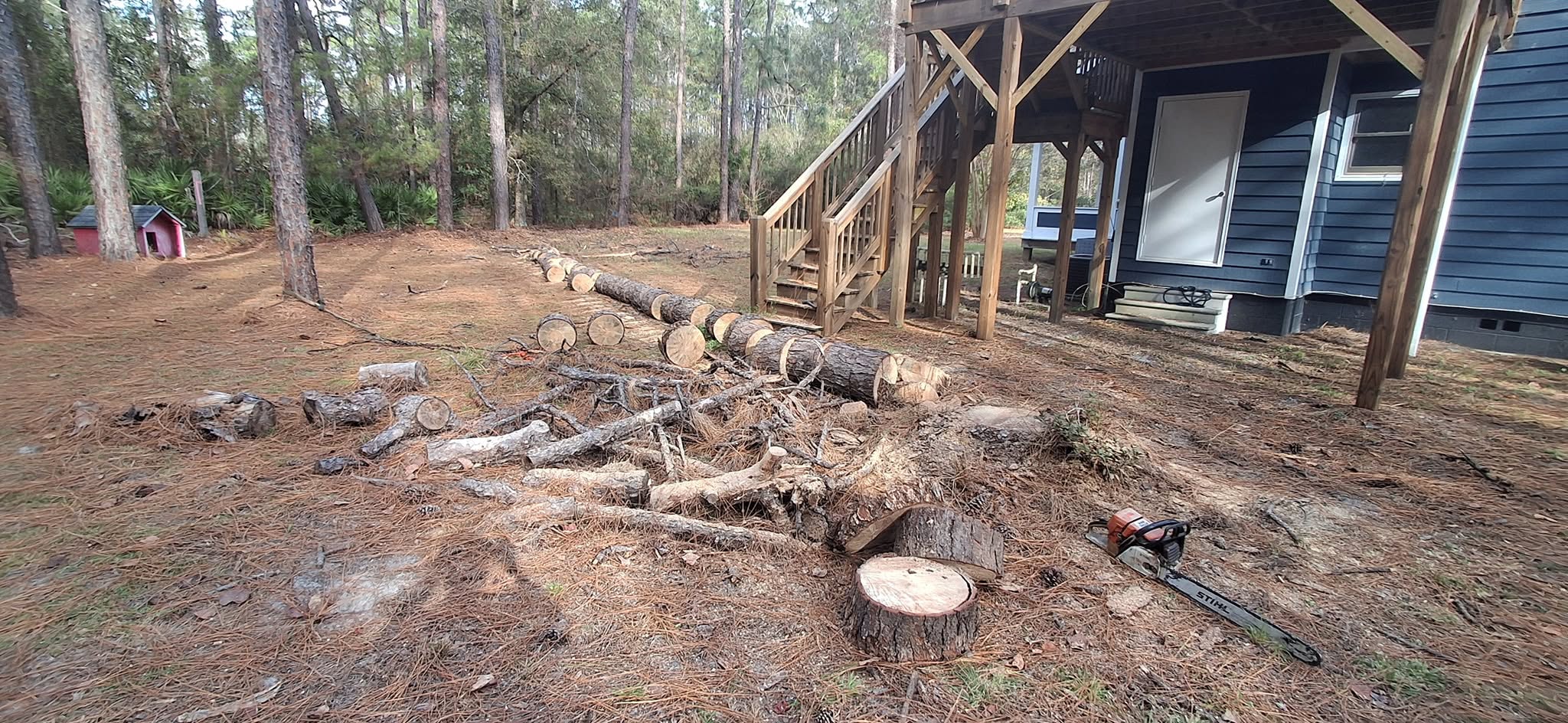
Healthy, well-shaped trees require occasional attention as branches grow toward roofs, driveways, walkways, and other areas of the property. We trim trees throughout Jesup, GA and surrounding communities based on tree size, canopy condition, branch clearance, and accessibility.
Some trees only need selective branches removed to improve their shape or create clearance. Others have dense canopies, heavy limbs, or growth extending over structures that requires more careful planning and controlled trimming.
Our approach focuses on removing unwanted growth while preserving the tree’s natural form, opening crowded areas, addressing problem branches, improving clearance, and cleaning up the resulting limbs and debris once trimming is complete.
02 — Quote by Clearance & Reach
Clearance &
Branch Removal
Overhanging branches can crowd a roofline, block a driveway, hang across walkways, or interfere with how you use the space below. Creating the right clearance around your property means identifying which limbs are causing problems and removing them without taking more from the tree than necessary.
The work changes with where the branches are growing. A low limb stretching across an open yard is much easier to address than one positioned above a roof, fence, or other obstacle where every cut needs to be controlled.
We also consider limb size and reach when planning the job. Once the necessary branches are down, final cleanup brings the area back into shape by gathering cut material and leaving the surrounding property neat.
03 — QUOTE BY Tree & Canopy
Canopy Thinning &
Tree Shaping
Dense, uneven, or crowded canopies can change the appearance and balance of a tree. We assess four key details
before shaping the canopy:
Approach
What Kind of Trimming Does Your Tree Need?
Tree trimming can range from a few targeted cuts to extensive canopy work. These three tiers
show how the job changes as branch removal becomes more involved.
PROJECT TIER
SELECTIVE PRUNING
A few problem branches need attention while most of the canopy stays untouched
Removes low, crossing, or unwanted branches where needed
Preserves the majority of the tree’s existing canopy
Creates breathing room around nearby structures and spaces
Focuses the work only where trimming makes a difference
Common for: healthy trees, low branches, minor clearance issues, routine pruning
PROJECT TIER
CANOPY PRUNING
Denser growth calls for more selective cuts throughout multiple areas of the tree
Opens crowded sections where branches compete for space
Removes crossing limbs that interfere with cleaner growth
Reshapes uneven areas without unnecessarily stripping the canopy
Balances appearance, clearance, and overall branch distribution
Common for: mature trees, dense canopies, uneven growth, multiple problem branches
PROJECT TIER
EXTENSIVE PRUNING
Heavy or widespread branch growth requires work across much of the tree’s canopy
Addresses multiple large, crowded, or overextended branches
Creates needed separation from roofs and surrounding structures
Corrects heavily unbalanced sections through selective removal
Requires the most detailed cutting and cleanup of the three tiers
Common for: mature trees, heavy canopies, major clearance needs, long-overdue trimming
Density Tier
Light Brush
Trees under 4" diameter, heavy scrub
Forestry mulcher handles most of it in one pass
Faster mobilization — often done in a day per acre
Kudzu or thick vines add time regardless of tree size
Typically the most straightforward quote to scope
Common in: recently abandoned fields, overgrown pasture, roadside strips
Density Tier
Mixed Timber
Trees 4–12" diameter, varied density
Mix of mulching and chainsaw work required
Larger trees need multiple passes or traditional felling
Hardwoods (oak, sweetgum) are slower than pine
Most residential wooded lots fall in this range
Common in: residential lots, secondary growth, older fields
Density Tier
Dense Hardwood
Trees 12"+ diameter, mature canopy
Traditional clearing and chainsaw crew required
Significant debris haul-off or on-site processing
Stump removal adds scope — grind or pull decision
Mature hardwood is the most labor-intensive tier
Common in: old-growth lots, farmland edges, timber tracts
Pruning Options
Trimming Techniques
ADVANTAGES
- Reduces excessive growth within the canopy
- Creates more space between crowded branches
- Maintains the tree’s overall natural form
- Removes unnecessary interior branch growth
CONSIDERATIONS
- Not every tree requires canopy thinning
- Excessive removal can affect tree structure
- The amount removed varies by tree condition
Best for: Front yards, foundation beds, entryways, and properties needing new planting areas.
ADVANTAGES
- Creates more clearance beneath tree canopies
- Opens space above driveways and walkways
- Removes low branches from high-traffic areas
- Maintains upper canopy while improving access
CONSIDERATIONS
- Branch removal depends on tree structure
- Too much clearance can affect natural balance
- Mature limbs may require more careful removal
Best for: Low-hanging branches, driveways, walkways, yards, and areas needing additional overhead clearance.
Local Trees,Experienced Hands
and Precise Cuts.
Tree trimming is about knowing what to remove, what to preserve, and where to make the cut. Around Jesup, we bring that judgment to every job, working with each tree’s natural structure while creating the clearance, balance, and finished appearance the property needs.
Common Questions
FAQ
How do I know when a tree needs trimming?
Trees may benefit from trimming when branches become crowded, cross one another, hang too low, grow toward structures, or interfere with driveways and walkways. The right approach depends on the tree and its surroundings.
Can tree trimming help create clearance around my property?
Yes. Targeted trimming can create additional space around roofs, fences, driveways, walkways, and other areas while preserving branches that do not need to be removed.
How much of a tree can be trimmed at one time?
The appropriate amount varies by tree species, size, condition, and trimming goal. Rather than removing unnecessary growth, the focus should be on addressing specific branches while maintaining a balanced canopy.
What happens to the branches after trimming?
Cut branches and smaller debris can be gathered and cleaned up as part of the job, leaving the work area neat once the trimming is finished.
Is tree trimming the same as tree removal?
No. Tree trimming selectively removes branches to improve clearance, shape, or canopy structure while keeping the tree in place. Tree removal involves taking down the entire tree and is a separate type of service.
Ready to Break Ground?
Free on-site quotes across Lancaster County and the Charlotte metro. No pressure, no obligation.
Happy With Our Work?
A quick Google review helps other homeowners find us and means the world to a local, owner-operated crew.
Landscaping & Lawn Care —
Jesup, GA to Blackshear, GA
Navigate
Services
Contact
Waters, Lawn & Garden
Jesup, Georgia
9:00AM-5:00PM


Service Area
Jesup, GA · Ludowici, GA · Walthourville, GA · Hinesville, GA · Glennville, GA · Baxley, GA ·Blackshear, GA
© 2026 Waters, Lawn & Garden · All rights reserved